
AI Agent Orchestration Platform: how work actually moves.
This is Orgabot's AI agent orchestration platform: twelve concepts, and no hidden thirteenth. Learn these and you can predict what Orgabot will do with any piece of work you hand it, including how it handles bot orchestration for multi-step tasks.
Everything is one of these twelve things.
Each one exists because leaving it implicit is how automation quietly loses a control. They are listed in roughly the order you meet them.
| Primitive | What it is | Example |
|---|---|---|
| Mission | One unit of work with a beginning and an end. A mission carries the instruction, the role that owns it, the project it touches, and the workflow it must run. Everything else hangs off it. | Fix issue 1290 in the web repository, owned by the engineering role. |
| Workflow | The definition a mission executes: the stages, in order, with the gates each one must satisfy. Workflows are data, so they can be versioned, shared between teams, and reasoned about without reading code. | Implement, verify, review, deliver, with a gate at the end of each stage. |
| Stage | One step of a workflow. A stage names who acts, which tools are reachable while it runs, and what has to be true before the mission may leave it. | Implement: the engineering role edits code in an isolated worktree. |
| Agent | A worker that performs a stage. Claude, Codex, Gemini, a local model, or something you wrote. Agents sit behind one adapter contract, so which one runs a stage is configuration. | Claude Code fills the engineering role; Codex fills another. |
| Human | A person filling a role. Humans act in the same model as agents: they hold roles, receive work, and make decisions that land on the same record. They are not a special case bolted onto the side. | Your head of engineering holds the role that approves merges. |
| Trigger | What starts a mission. An issue opened, a schedule firing, a build going red, a person asking. The trigger selects the workflow, so a scheduled audit and a hand-typed request do not accidentally share a lifecycle. | A GitHub issue, a failing CI run, or a duty on a weekly schedule. |
| Gate | A condition evaluated on evidence, not on an agent saying it is satisfied. Verification, review, approval, and policy are all gates. A gate that cannot be evaluated holds the mission instead of passing it. | Verification passes only on an observed exit code of zero. |
| Permission | The authority a role holds, clamped by the stage it is in. Permissions are granted, never inherited: an agent that can read a repository does not thereby get to push to it. | A role may push its branch; opening a PR needs policy or approval. |
| Tool | The only way an agent affects the world. Tools are brokered, policy-checked, and hold their own credentials, which is what keeps a secret out of the model that decided to use it. | A GitHub call made through the broker with the role's scoped token. |
| Event | The append-only record of what happened. Every state change, decision, and gate outcome is an event, which is why a run can be replayed rather than reconstructed from memory. | A verification decision, with who decided it and the exit code. |
| Outcome | How a mission ended: delivered, held, or refused, with the reason attached. A mission held at a gate never reports as a success. | Held: waiting on a required approval, branch and evidence intact. |
| Audit trail | The events, the decisions, and the identities behind them, in one queryable history. It is a byproduct of running the work, not a report generated afterwards. | orgabot timeline <mission> --compliance lists every gate decision. |
A bug report, from issue to production.
Some of these steps are an agent exercising judgment. The rest are conditions evaluated on evidence, where judgment is exactly what you do not want. The workflow does not distinguish between them at runtime: every step either satisfies its gates or the mission stops there.
- Issue createdYou
- Agent investigatesAgent
- Agent implementsAgent
- Tests runDeterministic gate
- Security gateDeterministic gate
- Human approvalYou
- Deploy to stagingDeterministic gate
- ValidationAgent
- Deploy to productionDeterministic gate
Investigate
The agent reads the issue, reproduces it, and reports what it found. Nothing outward-facing happens here, so it has latitude.
Implement
The change is written in an isolated worktree on its own branch. The agent can be wrong here without being dangerous.
Tests run
Your test command, run by Orgabot rather than by the agent that wrote the change, and judged on the observed exit code.
Security review
A reviewer that is not the producer. The agent that wrote the change is structurally ineligible to approve it.
Human approval
Routed to the role that owns the decision. Until it resolves, the mission waits with its branch and its evidence intact.
Promotion
One environment at a time, each hop carrying its own approval class, and confirmed by re-reading the world afterwards.
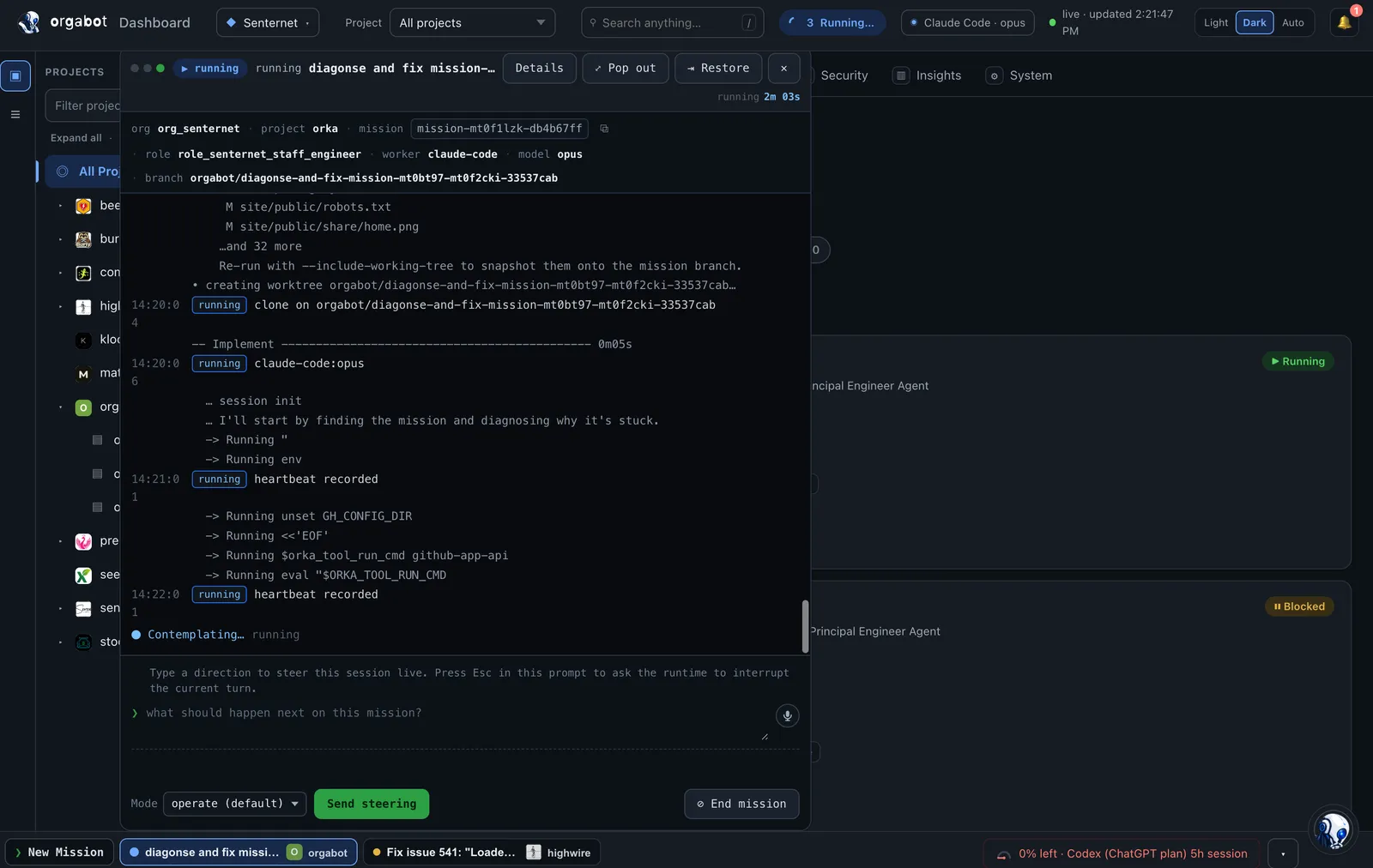
Roles are the unit of ownership.
Work is owned by a position, not by an account. That is what lets you replace the agent behind a role, hand a role to a person, or add a second reviewer without rewriting a workflow.
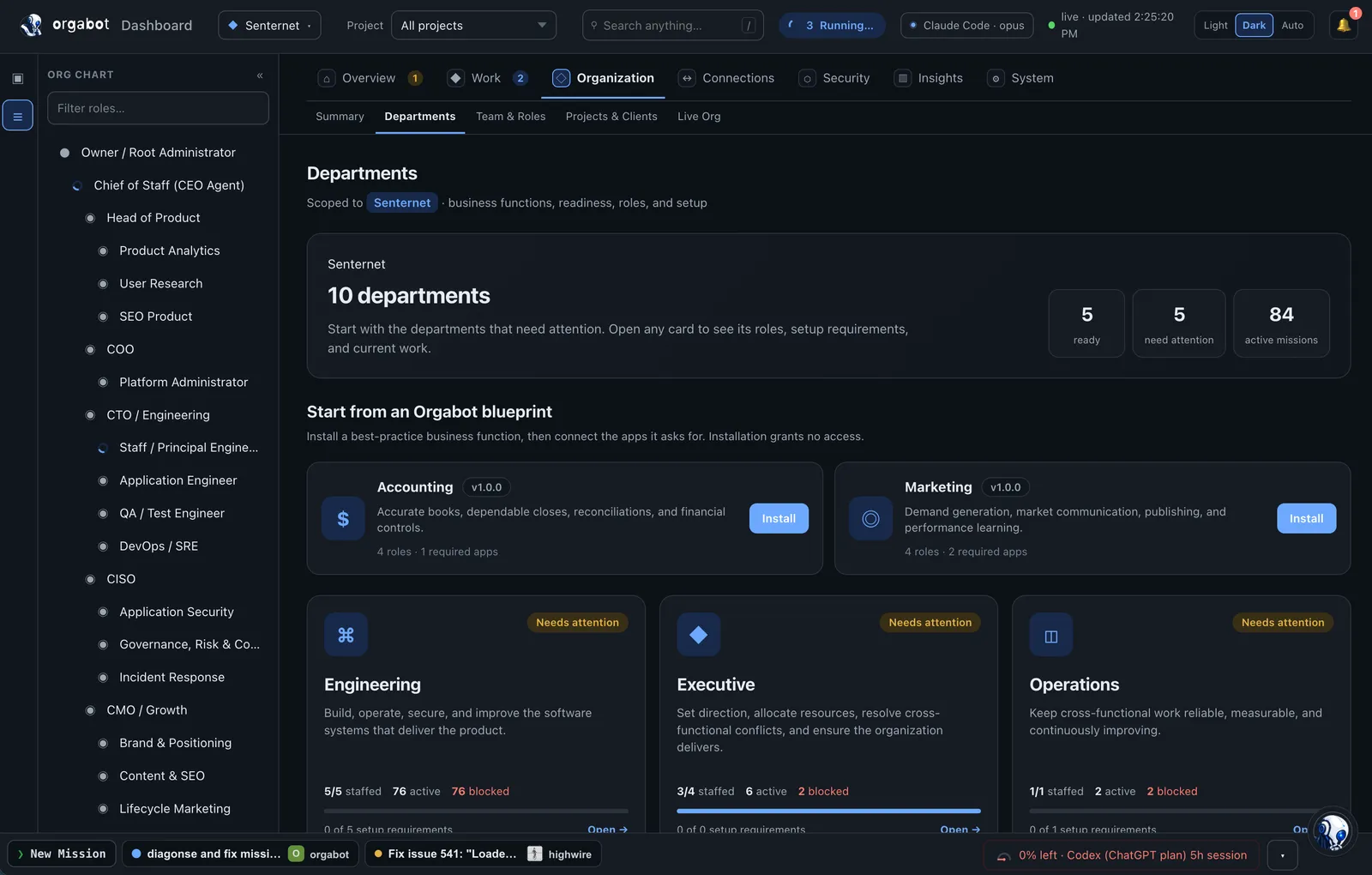
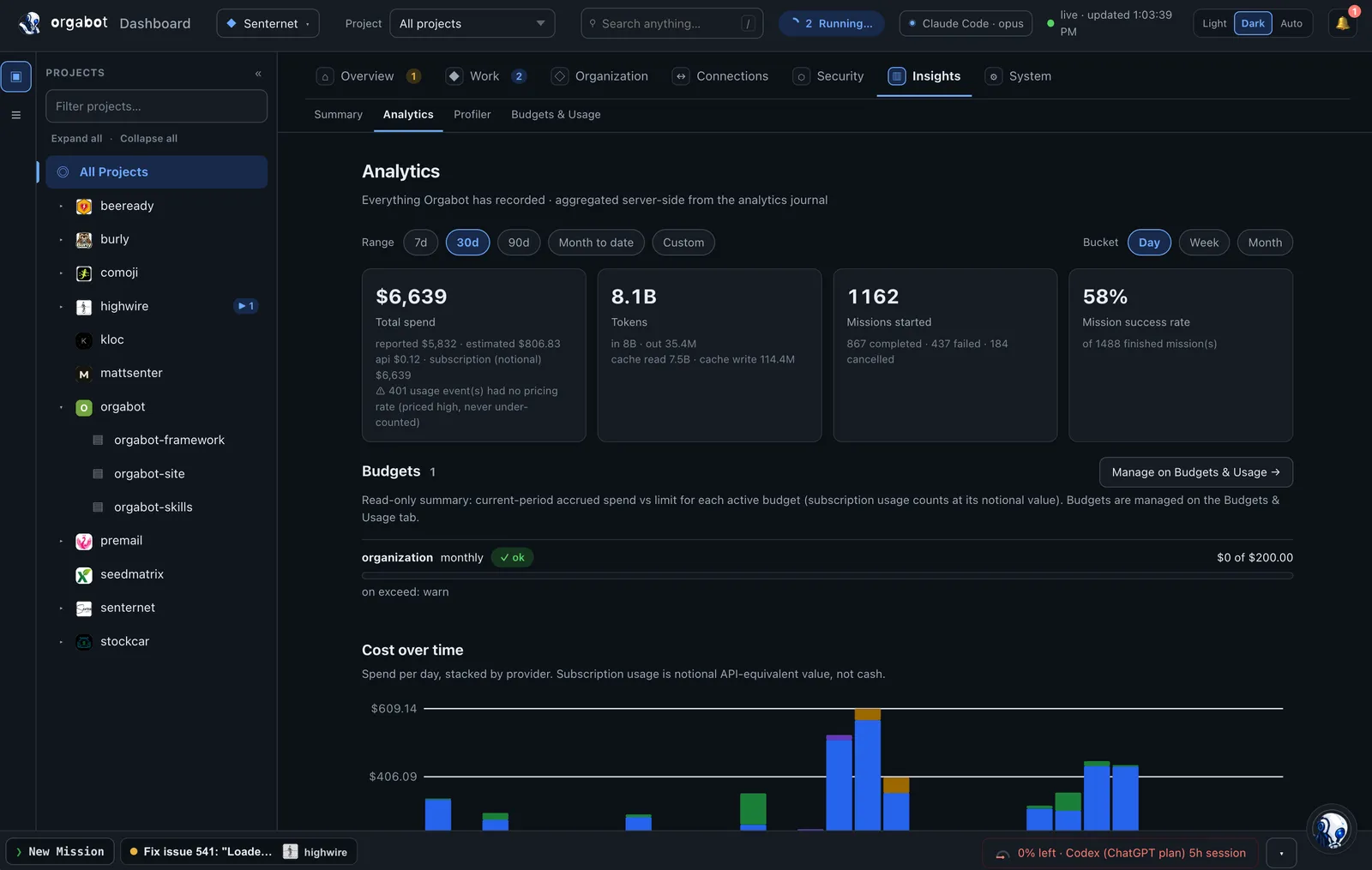
What it cost, and whether it worked.
Autonomy without a meter is a surprise waiting to happen. Spend, token usage, mission outcomes, and per-organization budgets are recorded as the work runs, so a budget can warn or stop rather than be discovered later.
Run it where the work already lives.
Orgabot is local-first: it runs on your machine, against your repositories, with your credentials, and needs no hosted service to function. Where it runs is your decision, not a pricing tier.
- On your laptop, with nothing leaving the machine
- On your own servers, inside your own network
- In public cloud, where your other infrastructure already lives
- Hybrid: a sensitive stage stays local while the rest runs hosted
Build the organization your agents can safely operate inside.
The model is small on purpose. Once the stages and gates are written down, most of the arguing about process turns into reading the definition.