
Enterprise AI agents: give every team autonomy without losing organizational control.
Orgabot is a multi-agent orchestration platform built for this tension: teams move at their own pace inside workflows they own, while the controls that cannot vary between teams are set once, above them, and cannot be turned off locally.
Turn your best practices into infrastructure.
Somewhere in the organization, a team already ships well. That process is currently a habit, a checklist, and one senior engineer who notices when a step is skipped. Written as a workflow, it becomes something every other team can adopt, and something that runs the same way at 2am as it does in a planning meeting.
- One workflow definition, adopted by every team that needs it
- Templates for the shapes you repeat: bug fix, release, incident, audit
- A team may tighten a shared workflow; it may not loosen a required gate
- Definitions are versioned data, so a change is reviewable like any other
- A workflow that omits a policy-required gate is refused before it can run
A team adopting a shared workflow can add stages, add reviewers, and add gates. What it cannot do is remove a gate the organization marked required. The attempt is refused at resolution, before a run exists, rather than logged and overlooked, because a control that can be quietly dropped by the team it constrains was never a control.
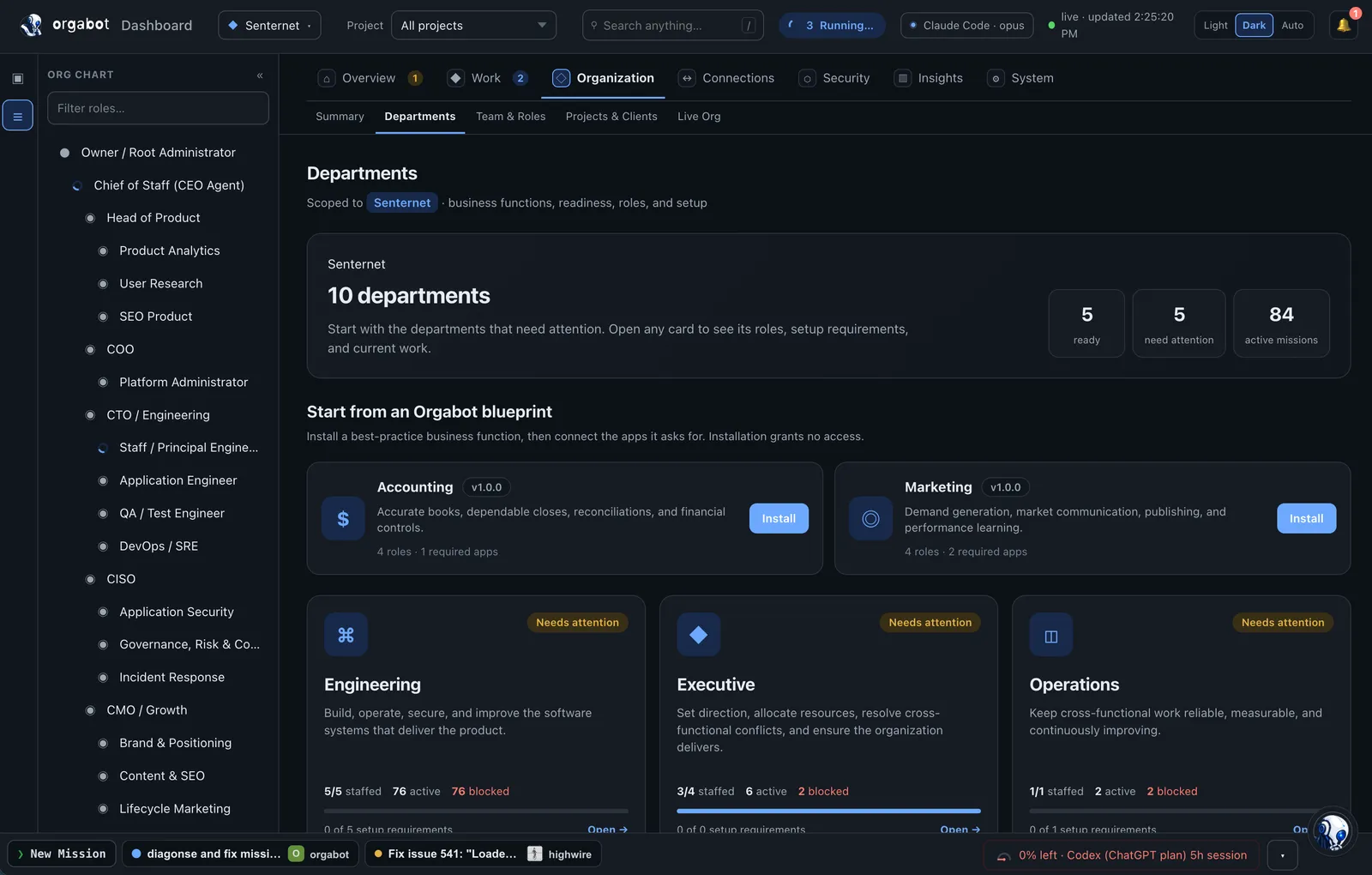
Enforcement that does not depend on discipline.
Policy in Orgabot is checked when a workflow is resolved, not when someone remembers to look. It fails closed, and it names what it requires rather than describing a posture.
- Required gates set once at the organization level
- A locked gate cannot be disabled further down the hierarchy
- Weakening a policy requires an approval minted for that exact change
- An unreadable policy blocks rather than defaulting to permissive
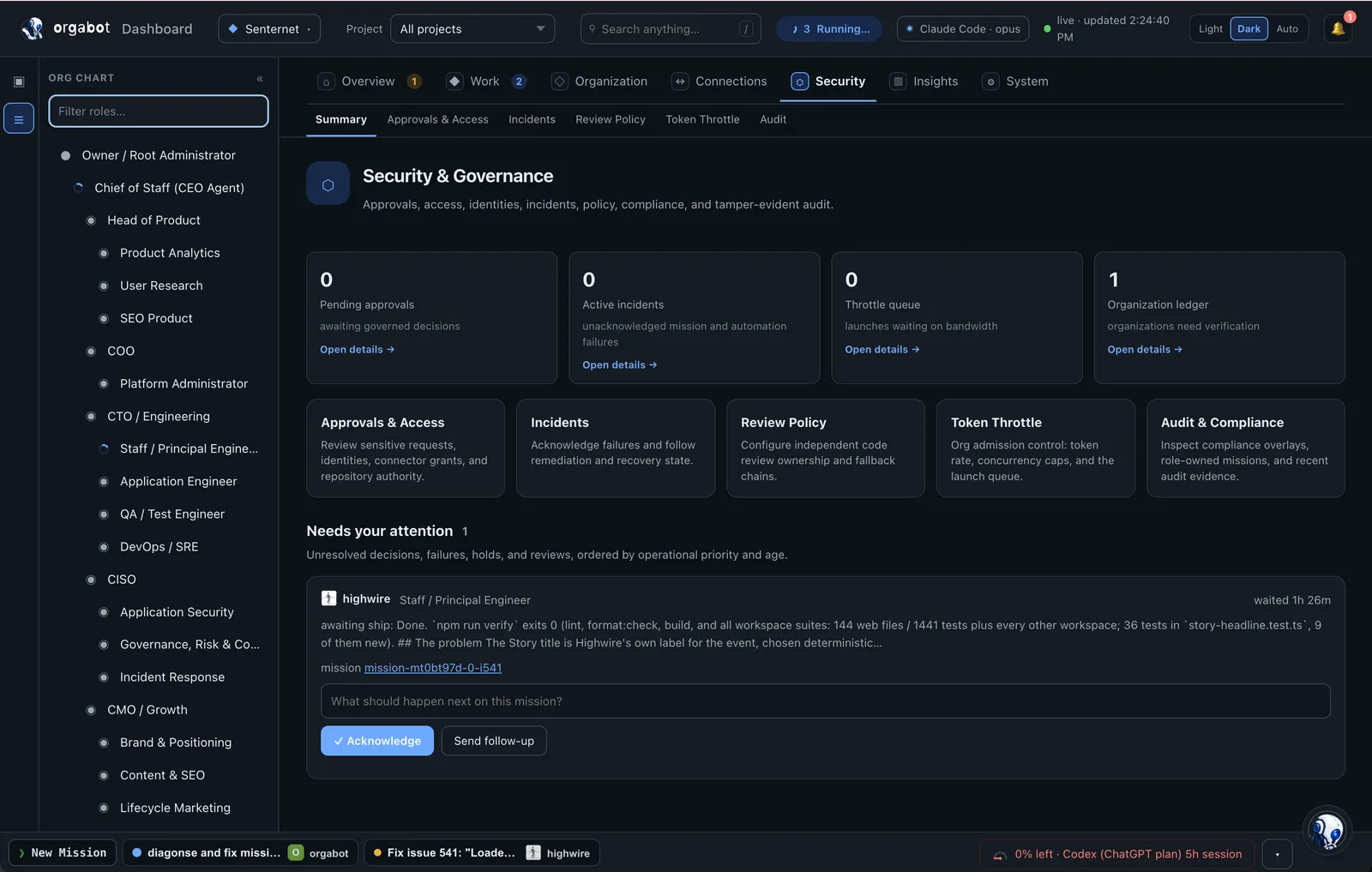
- Refused decisions are recorded as refused and surface as gaps
- Approvals routed to the role that owns the decision, not to a shared inbox
- An approval authorizes one named operation, not a class of them
- A producer can never approve its own work
- Held work keeps its branch, evidence, and context while it waits
- Escalation paths defined in the org chart rather than in a group chat
Several providers, one set of rules.
Large organizations do not standardize on one model, and should not have to. Different teams, different contracts, different data-residency constraints. Orgabot puts every worker behind one adapter contract, so the provider is a per-role decision and the gates around the work are identical regardless.
- Claude
- Codex
- Gemini
- Local models
- In-house agents
- Per-team provider choice
Provider choice is reversible
Because credentials never reach a model provider, changing one is a configuration change rather than a security event.
A stage can stay inside the network
Sensitive stages can be served by a local model while the rest of the workflow uses a hosted one, under the same gates.
No single-vendor dependency
If a provider degrades, the role behind the stage can be refilled without rewriting the process it belongs to.
Your infrastructure, your decision.
Orgabot runs on a laptop, on your own servers, in public cloud, or in a hybrid arrangement where a sensitive stage never leaves your network. Where it runs is an operations choice, not a plan feature.
- Local
- Private infrastructure
- Public cloud
- Hybrid
- Air-gapped stages
Evidence produced by doing the work.
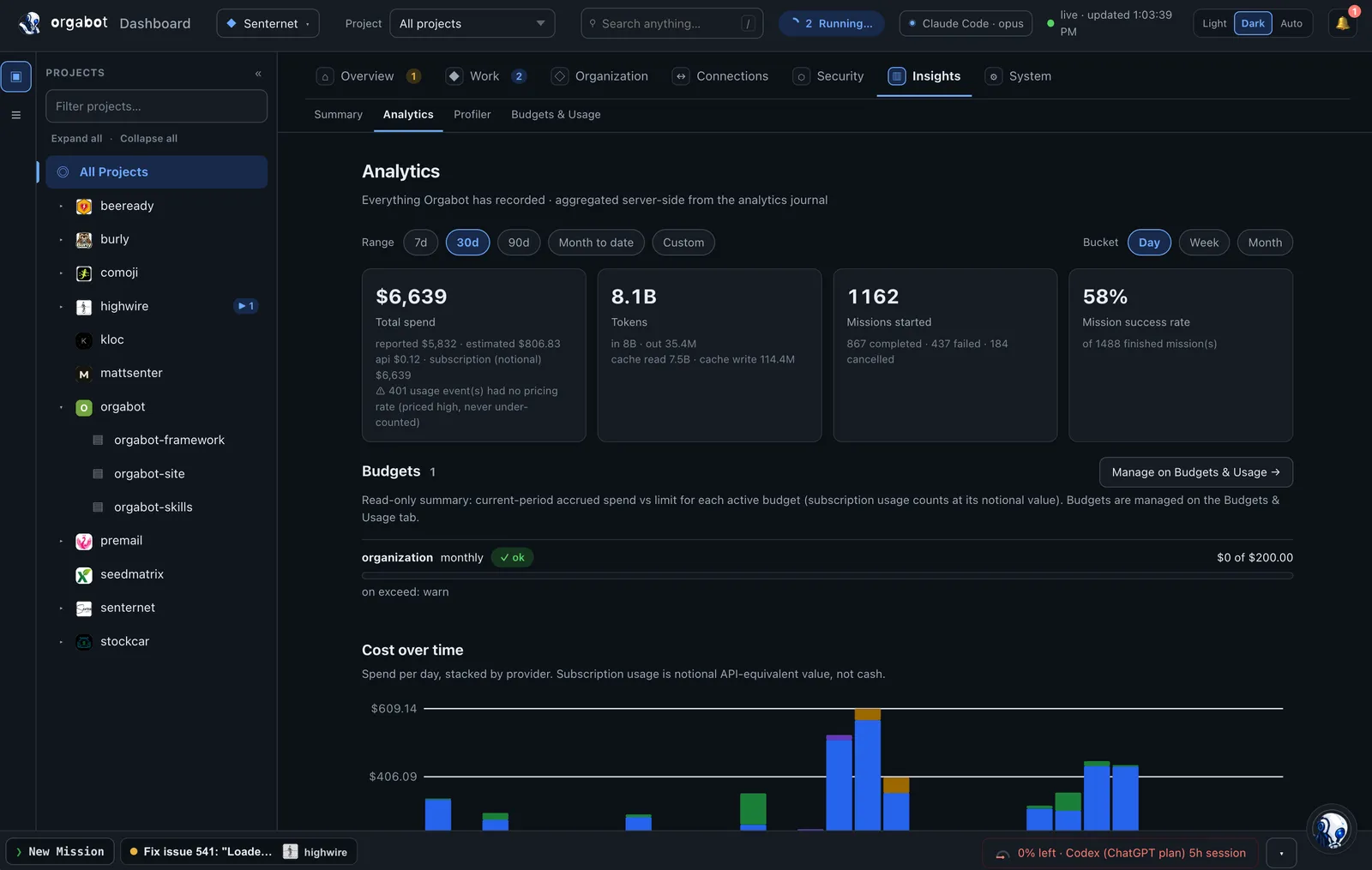
The record that permitted a change to advance is the same record an auditor reads later. There is no second reporting pipeline to reconcile, and no window in which the two disagree.
- Every elevated action recorded with the authority behind it
- Hash-chained ledger, so tampering is detectable
- Approval history with identities and reasons
- Compliance view that shows gaps rather than hiding them
- Runs replayable from the event history
SOC 2-ready, not SOC 2 certified
Orgabot supports the control families an audit examines: access scoping, change management, approval evidence, separation of duties, and monitoring. It does not hold a certification, and it will not claim one for you. What it removes is the part where the evidence has to be assembled by hand after the fact.
Build the organization your agents can safely operate inside.
If you are responsible for how work gets done across several teams, the parts worth pressure-testing are the policy and approval models. Bring the hard questions.