
Run a bigger company without building a bigger org chart.
One person can direct several specialized agents at once. What they cannot do is hold six half-finished processes in their head. Orgabot holds the process so you can hold the product.
The bottleneck is not capability. It is coordination.
A capable founder with good agents is already producing more work than one person can shepherd. Everything is in flight, nothing is tracked, two agents just edited the same file, and you are the only thing standing between a plausible-looking change and production. That is not an agent problem; it is an orchestration problem, and orchestrating AI agents is exactly the job Orgabot exists to do.
Six terminals and your memory
You are the scheduler, the reviewer, the release manager, and the only record of what was decided.
One process per kind of work
The workflow knows what comes next. You are asked only where a decision is genuinely yours.
You are still the approver
Nothing outward-facing happens without passing a gate you wrote. Leverage, not abdication.
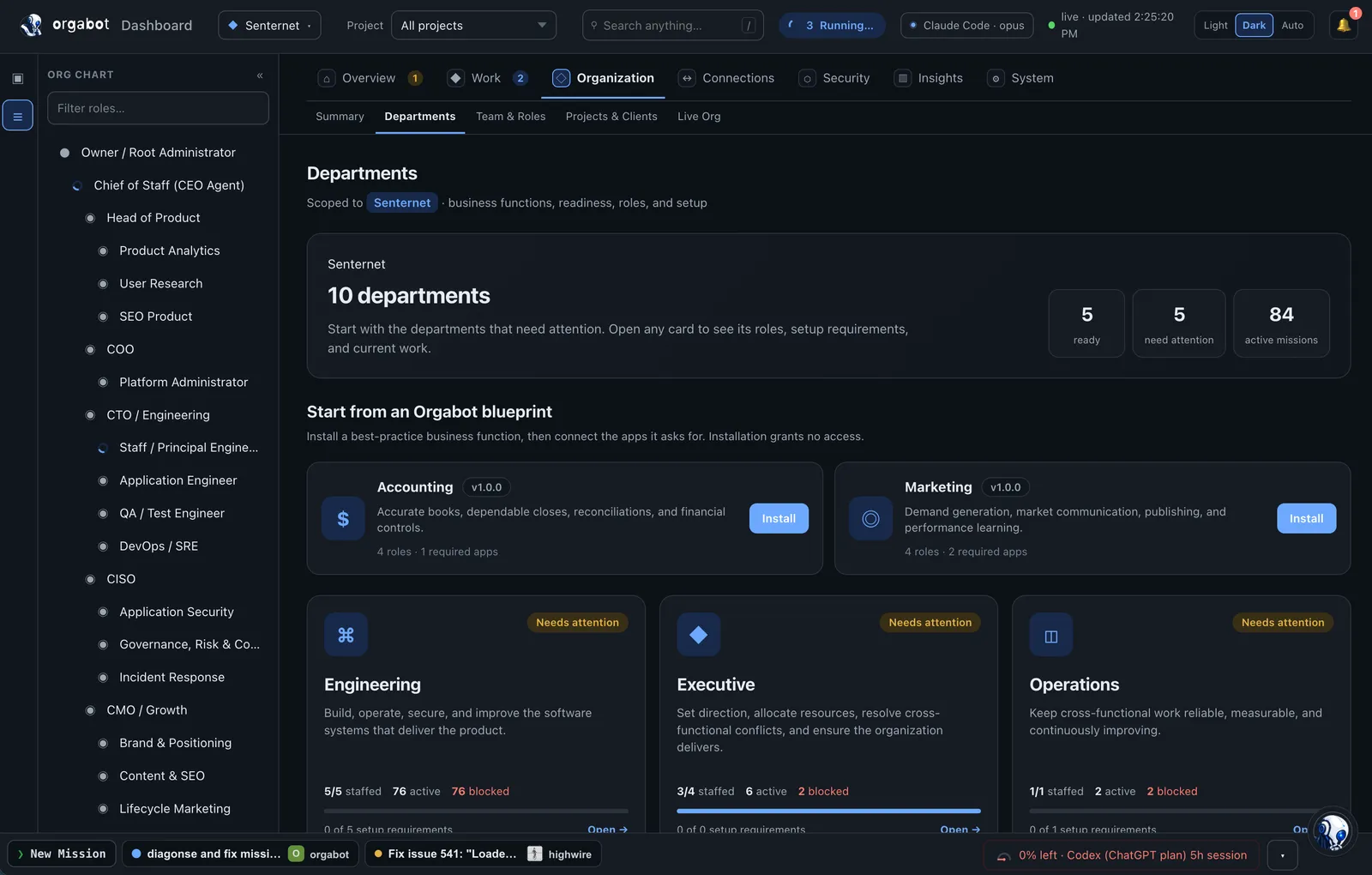
Staff the company you would hire for.
A role is a position, not a person. Write the six you actually need, fill each with an agent, and replace any of them with a human the day you make the hire, without touching the workflow.
- Engineering
- Picks up issues, works on its own branch, and delivers a draft pull request you review. It never merges without passing your tests and your approval.
- Testing
- Verification is run by Orgabot rather than by the agent that wrote the change, and judged on the exit code. This is the role that makes the others trustworthy.
- Research
- Reads competitors, docs, and issue history, and comes back with a summary rather than a pull request. A stage that produces an answer is a first-class outcome.
- Operations
- Watches builds and deploys, files an issue when something goes red, and hands the fix to the ordinary engineering workflow instead of paging you at midnight.
- Support
- Triages inbound, answers what it can answer, and escalates the rest to you with the context already gathered.
- Marketing
- Holds the socials and the site, and nothing else. A marketing agent with repository access is a mistake waiting for a bad afternoon.
File it, then look at what came back.
The loop is short on purpose. You describe the work, agents do it inside their stages, Orgabot verifies independently, and what reaches you is a reviewable change with evidence attached.
- Issue you filedYou
- Engineering agentAgent
- Your tests passDeterministic gate
- Second agent reviewsAgent
- You approveYou
- Merge and deployDeterministic gate
- Work continues while you are asleep, in a meeting, or on the other product
- Nothing reaches production without passing a gate you wrote
- The process you would follow if you had time is the process that runs
- Adding a specialist is writing a role, not a hiring round
- You stay the approver, which is the job that actually needs you
- You still review the code, because you are still accountable for it
- You still own the product decisions; agents do not have taste
- Agents get things wrong, which is exactly why the gates exist
- This is leverage on your time, not a substitute for judgment
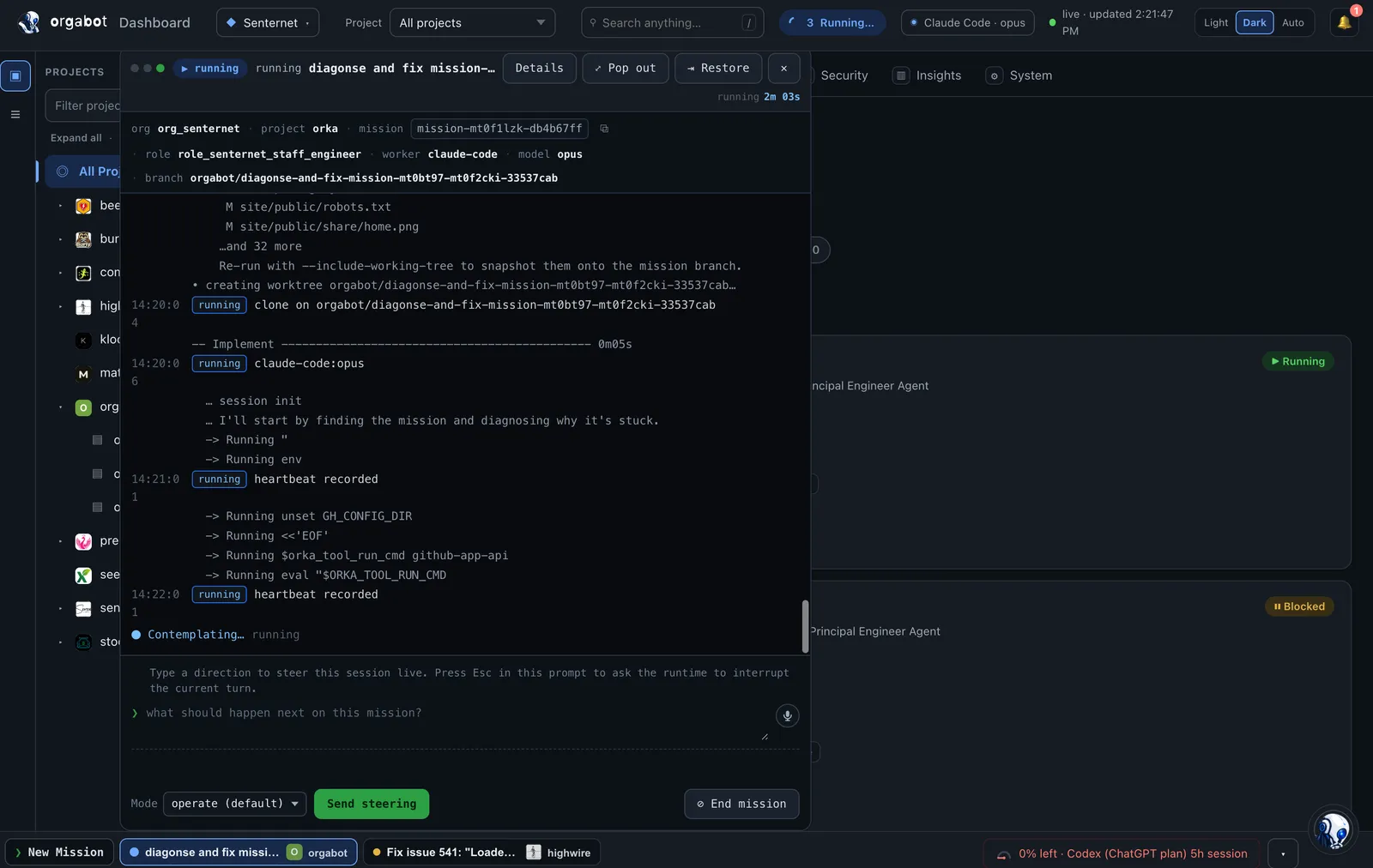
Autonomy with a meter on it.
Agents spend money while you are not watching, which is fine right up until it is not. Spend, tokens, and mission outcomes are recorded as work runs, and a budget can warn or stop rather than be discovered in a monthly invoice.
Build the organization your agents can safely operate inside.
Orgabot is built this way by a founder doing exactly this: it staffs and ships itself, one mission at a time. Come see how it is going.